

15 Oct “No pets” counts as a pet policy: what California’s SB 1296 means for rental owners
“No pets” counts as a pet policy: what California’s SB 1296 means for rental owners
Starting April 1, 2027, every California rental needs a written pet policy, even a no-pets one, and applicants have to see it before they pay an application fee. What SB 1296 requires, what it doesn’t, and how to get ready.
Not legal advice. This post is a general, educational overview of a new California law and of comments made by an attorney in a public webinar. It is not legal advice, is not a substitute for advice from a licensed attorney, and does not create an attorney-client relationship. Legacy Asset Management is a property management company, not a law firm. Laws change, and local rules vary by city and county. Before you change your forms or policies, talk to a qualified California landlord-tenant attorney.
For as long as most of us have rented out apartments, “no pets” in the listing was the whole pet policy. Starting April 1, 2027, that won’t be enough.
Governor Newsom signed Senate Bill 1296 on September 30, 2026. It adds a new section to the Civil Code, 1942.7.5, and the core of it is simple: every residential landlord in California needs a written pet policy, and applicants have to get a copy before they pay an application fee. That includes landlords who don’t allow pets at all.
On October 14, the Apartment Owners Association hosted a webinar on the new law with landlord-tenant attorney Michael Brennan of Brennan Law Firm and AOA president Jeff Faller. We watched it, then read the statute line by line. What follows is what the law says, with a link to the text everywhere we cite it, plus the practical advice from the webinar, labeled as the speakers’ views. It’s background reading, not a compliance plan for any particular property.
The short version
- It takes effect April 1, 2027. Brennan’s advice was to have everything in place by January 1, so you and anyone who helps you lease have a few months of practice first.
- Every property needs a written pet policy. “No pets” is a policy. So is “pets welcome, no rules,” and the law says you have to put that in writing too.
- It has to be easy to find. Link to it on the property’s website and in digital ads, including listing sites and rental search engines that allow a link.
- It goes out with every rental application, and the application needs a place for the applicant to acknowledge receiving it.
- Skipping it has a price. An applicant who wasn’t shown the policy, and who is ruled out by it or walks away because of it, can ask for the application fee back. You have seven business days to refund it.
- You still don’t have to allow pets, and assistance animals still aren’t pets.
What counts as a pet, and what counts as a policy
The new section opens with three definitions, and they drive everything else.
A pet is a “common household pet” as defined in Health and Safety Code section 50466(b): a domesticated animal, such as a dog or cat, that’s commonly kept in the home for pleasure rather than for commercial purposes. Brennan flagged the gray areas. A snake or a lizard isn’t unusual these days, but is it “common”? And “for pleasure” does real work: he described evicting tenants who were breeding and selling puppies out of a unit. That’s a business.
A pet policy is any written set of rules and conditions for keeping pets on the property. The statute says outright that a complete ban counts. It also says that if you place no rules or conditions on pets, the policy has to include a statement saying so. As Brennan put it, silence is no longer an option.
A pet addendum is the part of the lease that sets out the pet policy. Most owners will end up with two things: a short standalone policy for applicants, and an addendum for tenants who are approved to keep a pet. One well-drafted document can do both jobs.
Where the policy has to show up
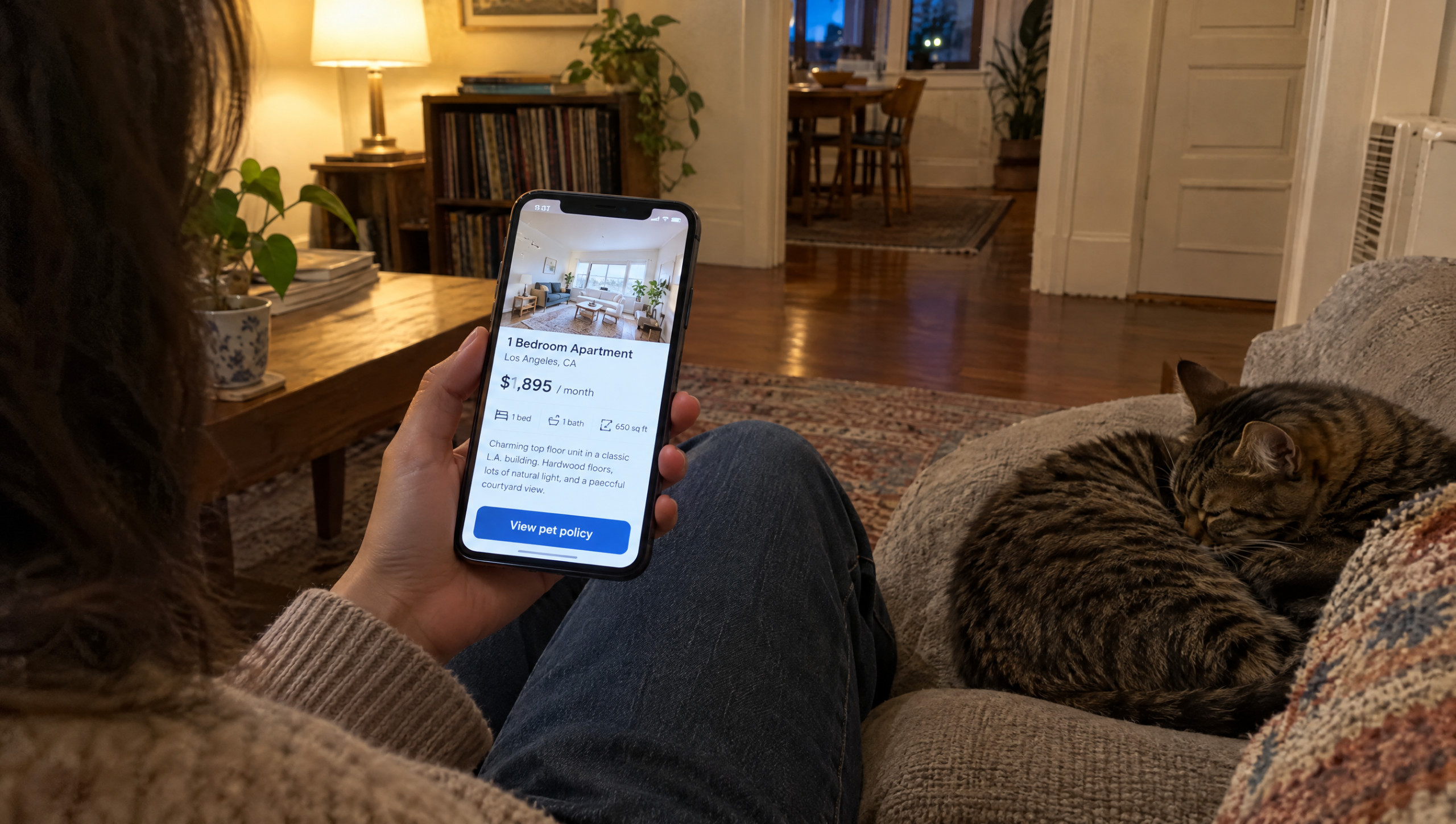
Subdivision (b) of section 1942.7.5 requires a hyperlink or other electronic access to the policy, where it applies:
- On the property’s website, if it has one.
- In any digital ad you fully control, and in ads on third-party sites, but only to the extent those sites let you include a link.
- In listing information you give a residential rental search engine, again only if the search engine supports a link.
Separately, a written copy of the policy has to go out with every rental application. If the application is electronic, the policy goes out electronically with it.
There’s also some protection for the listings you don’t control. If a third party scrapes or republishes your ad without your written permission and leaves the policy off, subdivision (c) says that’s not on you. Brennan’s tip for the sites that won’t take a link: screenshot the limitation and keep it in your records, so you can show you tried.
What the policy has to say
Subdivision (d) sets the content standard: “a clear, plain-language description of the rights, responsibilities, and requirements for tenant pet owners at the property,” along with any other material rules, conditions or restrictions on keeping a pet.
Brennan’s point was to notice the word rights. Most pet addenda in circulation today read like a list of obligations. His suggestion is to tie in rights tenants already have under existing law, like the return of their security deposit under Civil Code section 1950.5 and written notice before the landlord enters under section 1954, where 24 hours is presumed reasonable. If you plan to inspect for pet damage, say how that will work.
Then spell out the responsibilities in plain words. The examples he gave are the ones every manager knows: cleaning up after the dog, keeping it leashed outside the unit, and not leaving it to bark all day while the neighbors try to live their lives.
And fill in every blank before the policy goes out: any pet deposit, pet rent, the number of pets allowed, breed or size limits. Brennan sees blank checkboxes on leases all the time, and a blank on this form invites a claim that you didn’t comply. Two cautions on the numbers. A pet deposit is still security under section 1950.5, which since July 1, 2024 generally caps total security at one month’s rent, with a narrow exception for some small landlords. And as Brennan noted, local rent and eviction rules can limit pet deposits or pet rent, so check yours before you add either.
The acknowledgment line, and why the version date matters
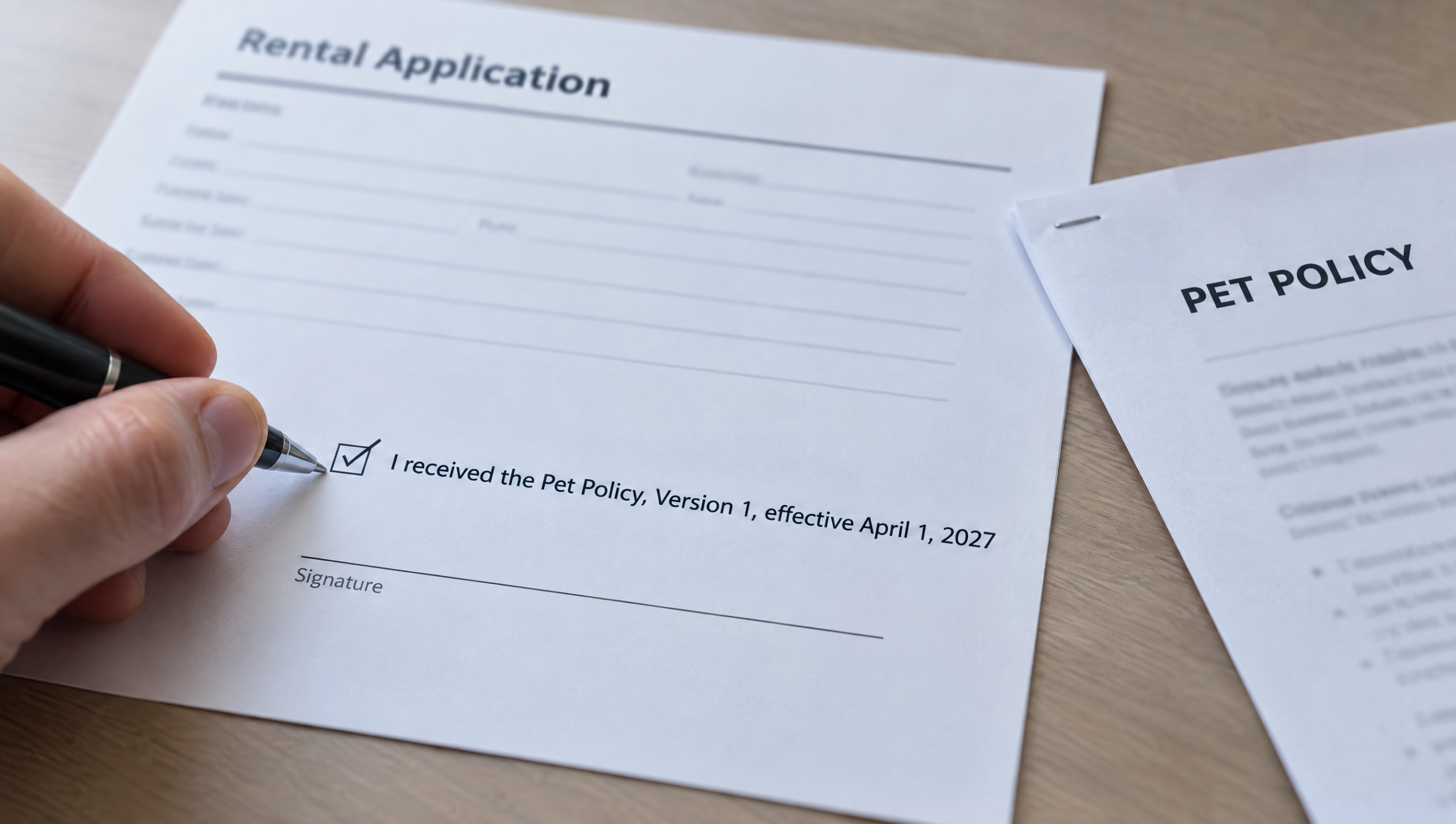
Subdivision (g) requires every rental application to include a space where the applicant acknowledges receiving the pet policy or addendum. Subdivision (e) lets you change your policy, but only for prospective tenants, and each applicant has to get the version in effect when they were handed the application.
Put those two together and you can see where the disputes will come from. Brennan expects some applicants to say, after the fact, “That’s not the policy I read.” His answer is to treat the acknowledgment as evidence, not a checkbox:
- Give every policy a version number and an effective date, and keep an archive of old versions.
- Have the acknowledgment name the version and the date it was provided.
- Don’t accept an application fee until the acknowledgment is back. Train anyone who handles applications on that point, and on what they should and shouldn’t say about pets and animals.
What it costs to get it wrong
The remedy is in subdivision (h), and it’s narrow. An applicant can ask for a refund of the application fee when all of these are true:
- You charged an application screening fee under Civil Code section 1950.6.
- You didn’t disclose the pet policy, as the law requires, before charging it.
- Because of that, the applicant is no longer eligible to rent the unit, or decided not to go forward.
The request has to be in writing. You then have seven business days to refund the fee, and once you do, you have no further obligation to that applicant under this section. Subdivision (f) adds a safe harbor: giving applicants the material terms of the policy counts as substantial compliance, and a minor error that’s fixed once someone points it out isn’t a violation.
Brennan called the exposure modest, and on paper it is. But he did the math for a busy listing: ten applicants, one approved, nine others who could each ask for, say, $50 back. That’s $450. His bigger worry is pattern. A record of not following one landlord-tenant law can be used as leverage in a dispute about something else entirely. He also expects some requests to arrive late, from applicants who chose another apartment and only later heard about the law. Whether a given request qualifies depends on why they dropped out, and a signed acknowledgment lets you skip that argument altogether.
How it fits with the screening fee rules you already follow
SB 1296 sits on top of California’s application fee law; it doesn’t replace it. Section 1950.6 still limits the fee to your actual out-of-pocket screening costs, requires an itemized receipt, and caps the fee at $30 per applicant plus inflation since 1998. Published 2026 caps depend on the inflation index used: the California Apartment Association says $65.86, Berkeley’s Rent Board says $68.96. Brennan used the lower number, and staying under it avoids the question.
How much SB 1296 adds depends on which screening process you use. If you consider applications in the order received and approve the first qualified applicant, you already send your written screening criteria with the application, and now the pet policy goes in the same packet. If you instead refund the full fee to everyone you don’t select (within seven days of choosing someone, or 30 days after they applied, whichever comes first), there’s little left for the new refund to add. And if you accept reusable tenant screening reports under section 1950.1, you can’t charge an applicant who provides one a screening fee at all, so there’s nothing to refund.
Pets, addenda and evictions
Subdivision (i) is short, and Brennan said it cuts both ways. A tenant’s failure to sign a pet addendum can’t be the sole basis for an eviction. The law doesn’t enlarge or shrink your ability to evict for a material breach of the lease. And you’re still allowed to require a signed addendum as a condition of approving a tenant’s request to keep a pet.
Brennan described the trap he sees most: a new tenant under pressure to move in asks for the keys before every document is signed, and the owner hands them over. If the pet addendum is one of the unsigned documents, you can’t evict over the missing signature. His approach is to make approval of any pet conditional on a signed addendum. If it ever came to an eviction, the issue would then be an animal that was never approved, which is a lease violation. The refusal to sign wouldn’t be the basis. It’s a fine distinction, and courts haven’t yet said how they’ll treat it.
A note for owners in the City of Los Angeles
Los Angeles already limits how much you can change an existing tenancy on your own. Under both the Rent Stabilization Ordinance (LAMC 151.09) and the Just Cause Ordinance (LAMC 165.03), you can’t add a new term with a change-of-terms notice and then evict for breaking it unless the tenant agreed to it in writing. Both ordinances also say you can’t change the terms to prohibit pets and then evict over a pet that was kept and allowed before the change, unless the pet is a nuisance that wasn’t fixed after proper notice.
That came up in the Q&A. An owner asked about a long-term tenant who had always been allowed a dog, but whose current dog had become destructive. Brennan’s suggestion was to start with a letter that documents the problem, says the dog is still allowed, and asks for more control, with no reference to the tenant’s age or any other protected characteristic. If that doesn’t work, a change in terms might be next, reviewed by an attorney first. But in Los Angeles, he said, don’t assume you can evict if the tenant won’t sign it.
Another question was whether current tenants have to sign the new policy. His short answer was no: SB 1296 is about applicants and the application process, not existing tenancies.
Assistance animals are not pets

Subdivision (k) says the new section doesn’t change anyone’s rights or obligations under state or federal law for service animals, support animals or other assistance animals. That matters, because California’s fair housing regulations treat assistance animals very differently from pets. Under California Code of Regulations, title 2, section 12185(d):
- No pet fee, extra rent, additional security deposit or liability insurance requirement can be charged in connection with an assistance animal.
- No breed, size or weight limits apply, other than specific ADA rules for miniature horses.
- The tenant can be held responsible for damage the animal causes, beyond ordinary wear and tear.
Brennan’s warning was about words. An application that asks “Do you have any pets or animals?” pulls assistance animals into a pet process, and that’s how a pet deposit ends up charged where it never should have been. His recommended wording asks only about pets the applicant intends to keep, tells applicants not to list assistance animals, and explains that they can request a reasonable accommodation at any time. Ask about a pet’s type, breed, weight and age, but only for pets.
He also suggested two separate documents: a pet addendum, and an animal addendum for reasonable accommodations, with rules that overlap but aren’t identical. And he urged owners to have a written reasonable accommodation policy, because it’s one of the first things fair housing investigators ask for.
He shared a case he’s handling now. A tenant’s pet bit someone. Once the tenant got notice to remove it, the animal became an emotional support animal, with letters from doctors, followed by a complaint to the California Civil Rights Department. His advice if a pet suddenly becomes an assistance animal: call an attorney right away. Both speakers stressed that an accommodation doesn’t excuse a dangerous animal, but the rules on when a specific assistance animal can be excluded are narrow. Don’t improvise this one.
If a portal or vendor takes your applications

A lot of owners don’t hand out paper applications anymore. They send a link, and a third-party platform takes the application and collects the fee. Does that move the responsibility to the vendor?
Brennan thinks not. Every duty in the statute falls on “a landlord or their agent,” and the statute doesn’t define “agent.” Under general agency law, in his view, a vendor you choose to take applications and collect fees is acting as your agent, so its mistakes become yours. Faller added that large platforms serving all 50 states don’t always update quickly for one state’s law, so don’t assume yours will be ready by April.
Brennan’s six safeguards:
- Check the portal. It should show the policy before payment and record a timestamped acknowledgment. Ask the vendor directly, in writing if you can.
- Contract for compliance. Ask how the vendor will handle a refund demand, especially one aimed at you for a fee they collected.
- Send the policy yourself, first. Before you send the application link, email the pet policy and ask the applicant to reply in writing that they’ve read it and want to proceed. Send the link only after that reply comes back. He called this the best safeguard for now, and suggested making it part of your written screening procedures.
- Test it and screenshot it. Check at launch and with every new policy version. Save the policy and payment screens.
- Refund first, sort it out later. If an applicant comes to you, pay the refund promptly, then seek reimbursement from the vendor. Ideally, the contract already says how that works.
- Watch the fee rules. Make sure the vendor stays under the section 1950.6 cap and gives applicants an itemized receipt.
One more point from the Q&A applies to us directly. Brennan cautioned owners against assuming a broker or manager takes this off their plate, since that person is the owner’s agent too. He’s right. Hiring help doesn’t move the legal responsibility. What it should do is put the process in the hands of people who run it every week, and you should feel free to ask any manager, including us, to show you exactly how they handle it.
A checklist for getting ready
This follows the compliance checklist Brennan walked through at the end of the webinar:
- A written pet policy for every property. They can differ from one property to the next.
- A clear pet status: no pets, pets with rules, or pets with no rules. (He wouldn’t recommend the last one.)
- Tenants’ rights and responsibilities in plain language.
- Every blank filled in.
- A version number and effective date on each policy, with old versions archived.
- An assistance animal carve-out on the application.
- Links on your website and on every listing that allows them, with screenshots of the ones that don’t.
- The policy attached to every application, and a signed acknowledgment before any fee is taken.
- A refund procedure built around seven business days, and everyone who handles applications trained on it.
- Forms reviewed by a lawyer. He advised against “home-growing” edits to an association’s forms.
He also expects fair housing testers to start checking listings for the link once the law takes effect. If a platform allows a link and yours isn’t there, assume someone will notice.
What the law doesn’t require
Brennan saved the good news for last, and it’s in subdivisions (j) and (l). You don’t have to allow pets; a complete no-pets policy is fine, as long as it’s written down and disclosed. You don’t have to build a website for a property that doesn’t have one, or advertise anywhere in particular.
You also keep the authority to adopt, amend, interpret and enforce your pet policy, and to deny or restrict pets for reasons including health or safety, property conditions, insurance requirements or business reasons. Notice the word is pets. None of it overrides the rules for assistance animals.
What this means if we manage your property
For the owners we work with, this is our job to set up, not yours. We’ll be in touch well before April to settle each property’s pet policy, so it’s written, dated and ready to go out with every application. If you have a question about your building in the meantime, or you’re thinking about professional management, contact Legacy Asset Management.
Disclaimer: This article is for general informational and educational purposes only. It is not legal advice and should not be relied on as such. It summarizes the text of a new California statute, related laws and regulations, and the opinions of third-party speakers, which may not reflect how courts will apply the law or fit your situation. Reading it does not create an attorney-client relationship. Legacy Asset Management is not a law firm and does not provide legal advice. Consult a licensed California attorney before changing your rental application, pet policy or lease forms.
Sources
- SB 1296 (Durazo), Chapter 1025, Statutes of 2026: chaptered text adding Civil Code section 1942.7.5
- Health and Safety Code section 50466 (definition of “common household pet”)
- Civil Code section 1950.6 (application screening fees)
- Civil Code section 1950.5 (security deposits)
- Civil Code section 1950.1 (reusable tenant screening reports)
- Civil Code section 1954 (landlord entry and notice)
- Cal. Code Regs., tit. 2, section 12185 (assistance animals in housing)
- Los Angeles Municipal Code section 151.09 (Rent Stabilization Ordinance, evictions)
- Los Angeles Municipal Code section 165.03 (Just Cause Ordinance)
- Apartment Owners Association webinar, “Breaking News: SB 1296 Changes Things,” with Michael Brennan, Esq. and Jeff Faller (October 14, 2026)
What should your building be earning?
A free rental analysis, with no obligation. We will tell you what the units should rent for, what is holding them back, and what we would do first. If you own in West Adams, our property management page sets out how we work.